
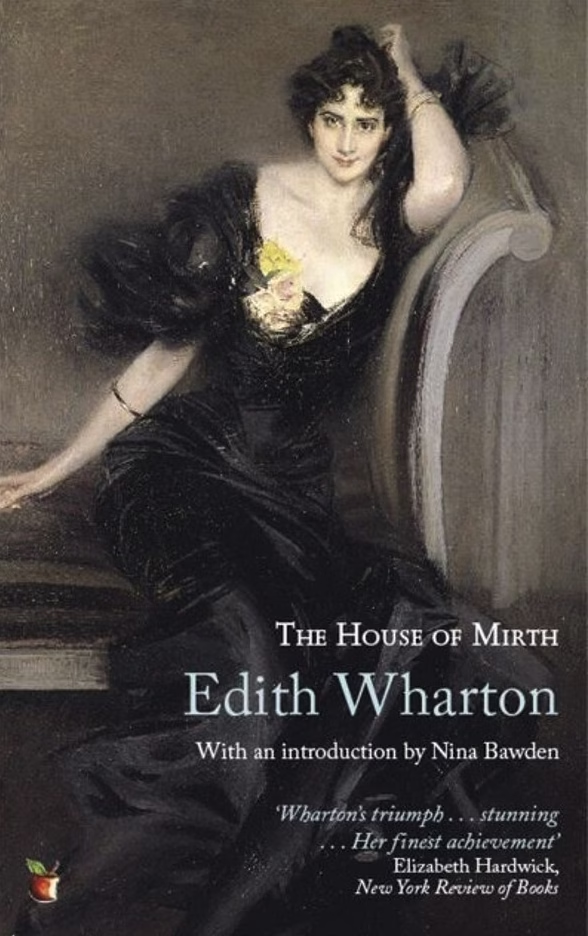
Our book group choice for April 2026 is The House of Mirth by Edith Wharton. The novel serves as a devastating critique of the commodification of human relationships within the gilded cage of New York’s turn-of-the-century elite.
The narrative chronicles the tragic trajectory of Lily Bart, a well-born but impoverished woman whose survival hinges on securing a wealthy marriage. Governed by an aesthetic sensibility that demands luxury, Lily finds herself trapped in a socio-economic paradox: she is a commodity designed for the marriage market, yet her residual moral integrity consistently sabotages her opportunities for financial security.
Wharton employs a deterministic realism to chart Lily’s gradual ostracisation from her social stratum. As Lily resists the mercenary compromises necessary to maintain her status, her precarious position is weaponised by the very elite she seeks to appease. False accusations of sexual indiscretion, engineered by those protecting their own social capital, accelerate her descent. The novel operates as a rigorous sociological study of a leisure class that relies on rigid, hypocritical codes of conduct to enforce conformity. Within this framework, social capital is inextricably linked to economic leverage; Lily’s failure to convert her beauty into permanent wealth results in her systematic devaluation.
The tragic climax underscores the absolute lack of agency permitted to a woman outside the protective custody of wealth or matrimony. The House of Mirth remains a seminal examination of class structure, gendered entrapment and the corrosive synthesis of social Darwinism and capitalism.
Discussion Questions
- Lily Bart clearly wants security and wealth, yet she repeatedly self-sabotages her own chances to marry rich men like Percy Gryce. Why do you think she hesitates at these critical moments? Is she holding out for something better, or is her conscience stopping her?
- The title comes from the Bible verse: “The heart of the wise is in the house of mourning; but the heart of fools is in the house of mirth.” In what ways is the high society Wharton describes a “house of fools”? How do the constant parties and gossip hide a colder, more dangerous reality?
- Throughout the novel, Lily is admired for her beauty, elegance, and taste—almost like a valuable painting or statue. How does viewing herself as an object to be admired limit her ability to make her own choices?
- Selden speaks of a “Republic of the Spirit”—a life of intellectual freedom outside of high society’s material obsession. Does he offer a genuine alternative for Lily, or is he judging her from a safe distance without ever offering real help?
- At the beginning of the novel, Rosedale is treated as a social outsider. By the end, he is one of the few people who treats Lily with practical kindness. How did your perception of Rosedale change over the course of the book? What does his rise say about the power of money vs. old family names?
- Bertha Dorset commits several social transgressions but manages to keep her high standing by turning society against Lily. Why is Lily punished so harshly for things she didn’t actually do, while wealthy women like Bertha escape consequences?
- Lily holds onto Bertha Dorset’s love letters to Selden, which could easily clear her own name and ruin Bertha’s reputation. Why does Lily refuse to use them as blackmail, even when she is desperate and broke?
- Lily’s death from an overdose of sleeping medication is left slightly ambiguous. Do you view her death as a tragic accident, a deliberate choice, or an inevitable surrender to a society that left her no room to live?
- Could Lily have found happiness if she had simply walked away from high society earlier, or was she too dependent on luxury and social status to ever survive outside of it?
- In the final scene, Selden sits by Lily’s bed, believing he has finally found the “word” that could have saved them or brought them together, though it is never spoken aloud. What do you think that unspoken word was?
Individual Ratings
Sue's Rating 

Baljit's Rating
EmmaT's Rating
DKB's Rating
Jo's Rating 