
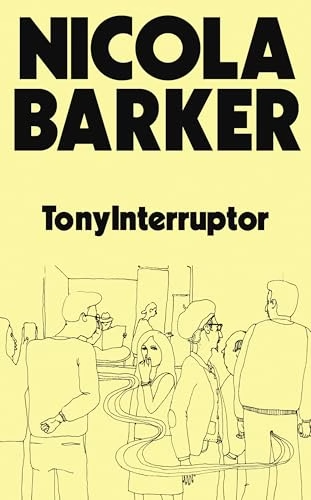
Our book group choice for March 2026 is TonyInterruptor by Nicola Barker. In a dimly lit Canterbury jazz club, trumpeter Sasha Keyes is deep in a fearless improvisational solo when the unthinkable happens: a middle-aged man stands up and politely asks, “Is this honest? Are we all being honest here?”
This single, destabilising query—dubbed the “First Interruption”—is captured on a smartphone by bored teenager India Shore. When the video goes viral, the man is christened #TonyInterruptor, a memeified folk hero (or villain) whose unquenchable urge to disrupt live cultural events challenges the very social contract of art.
Nicola Barker’s 2025 novel is a dizzying, maximalist exploration of the fallout. The narrative radiates outwards from that one moment, dragging a cast of eccentric, interconnected characters into its wake:
- Sasha Keyes: The musician whose artistic integrity is wounded by the suggestion of artifice.
- Lambert Shore: India’s father, a po-faced architecture professor who becomes obsessed with the intellectual implications of the heckle.
- Fi Kinebuchi: The “Queen of Strings” and Sasha’s bandmate, whose own insecurities about performance are laid bare by the digital storm.
- John Lincoln Braithwaite: The eponymous “Tony,” a man who despises algorithms and seeks a “revelation” through the clumsy, human friction of the unexpected.
Barker utilises her signature manic prose — rife with digressions, ellipses, and sharp comedic asides — to skewer 21st-century pretension. As the story jumps forward three years, it evolves from a satire on “cancel culture” into a profound meditation on the “Buddhist Lineage of Mis-steps,” suggesting that our failings and interruptions are more authentic than our curated successes.
Discussion Questions
- Barker structures the novel around the initial disruption of a live performance. In literary terms, how does this “interruption” function as both a narrative catalyst and a formal device? Analyze how Barker’s erratic syntax—punctuated by parenthetical digressions, ellipses, and sudden shifts in perspective—embodies the concept of the interruption on a micro-stylistic level.
- The structural dynamics of TonyInterruptor heavily mimic the formal mechanics of jazz improvisation—relying on recurring themes, polyphonic perspectives, and sudden shifts in tempo. How does Barker utilize this musical framework to subvert traditional, linear storytelling? To what extent does the text argue that human relationships and histories are themselves formless, collaborative improvisations?
- When Sasha Keyes is singled out by the Interruptor, his artistic and personal equilibrium is entirely upended. Explore how Barker maps the anxieties of surveillance capital and contemporary call-out culture. How does the text interrogate the psychological burden of public disgrace when an individual’s identity is stripped of context and broadcast to an online collective?
- Barker’s narrative traces a complex web of eccentric characters over a three-year timeline, tracking what the text positions as a “lineage of mis-steps.” How does the novel recontextualize failure, clumsiness, and social friction? Does Barker argue that embracing human error and interpersonal awkwardness serves as a vital counter-strategy to the slick, optimized perfection demanded by digital platforms?
- The relationship between the older, analog-driven characters (like Braithwaite and Lambert Shore) and the digitally native younger generation (like India Shore) drives the narrative engine. How does Barker negotiate this intergenerational divide? Is the text nostalgic for a pre-digital era of unrecorded cultural experience, or does it offer a more ambivalent, symbiotic view of how these generations reshape one another’s realities?
- The “First Interruption” explicitly violates the unwritten social contract governing performance spaces. Analyze the spatial politics of the novel. How do different environments—the Canterbury jazz club, academic lecture halls, and the domestic spaces of the Shore family—dictate behavior, and how does the collapse of boundaries between private intent and public consumption reshape these spaces?
London Review Bookshop - Critics have noted Barker’s ability to blend deep philosophical inquiry with anarchic, maximalist humor. Assess TonyInterruptor within the tradition of contemporary British satire. How does Barker use the absurd and the grotesque (such as the visceral, highly specific character descriptions, like Sasha Keyes’s inner “17-year-old Rottweiler”) to dismantle cultural pretension without falling into cynicism?
The Bookseller - The novel concludes with a deep preoccupation with communication, miscommunication, and what remains unsaid in the wake of hyper-connectivity. How does TonyInterruptor address the limits of language? Ultimately, does the text suggest that true understanding between individuals is achieved through the accumulation of discourse, or in the silent, unresolved spaces opened up by a rupture?
Individual Ratings
Baljit's Rating 
