
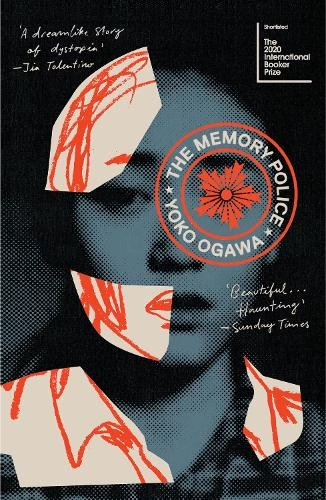
Our book group choice for May 2026 is The Memory Police by Yoko Ogawa. The novel is a haunting allegorical exploration of state-enforced amnesia, totalitarian surveillance, and the gradual dissolution of the human psyche.
Set on an unnamed island, the narrative follows an unnamed novelist navigating an authoritarian regime that systematically orchestrates the “disappearance” of physical concepts and material objects—ranging from harmless items like ribbons and hats to foundational ecological elements like birds and roses. These disappearances are not merely physical; they carry an existential weight, as the island’s inhabitants experience a simultaneous cognitive erasure, losing the vocabulary and memory of the lost objects.
The narrative arc accelerates when the protagonist discovers that her editor, R, belongs to a small, persecuted minority incapable of forgetting. To shield him from the brutal incursions of the Memory Police—the militarised enforcement arm of the regime—she hides him in a secret chamber beneath her floorboards. This act of concealment shifts the novel’s focus toward the spatial and psychological politics of preservation, transforming the act of writing into an endangered site of historical resistance.
Through a stark, melancholic realism, Ogawa examines the relationship between material culture and identity. As the physical world shrinks, the characters’ internal landscapes suffer a parallel atrophy. The text functions as a profound critique of compliance and collective trauma, illustrating how a population can be coaxed into normalising its own intellectual and emotional starvation. Ultimately, The Memory Police transcends standard dystopian tropes to offer a philosophical meditation on ontological decay; as the body politic surrenders its collective memory, the physical self eventually undergoes a final, literal disappearance, leaving behind a sterile landscape defined entirely by absence.
Discussion Questions
- Ogawa’s narrative demonstrates a direct causal link between the physical disappearance of objects and the cognitive erasure of their concepts. How does the novel critique the materialist basis of human consciousness? Analyze how the characters’ ontological stability—their very sense of being—is systematically eroded as their material vocabulary is stripped away.
- The secret chamber beneath the protagonist’s floorboards functions as a microcosm of historical preservation within a landscape of forced amnesia. Contrast this subterranean space with the panoptic, highly visible surveillance of the island at large. How does Ogawa use spatial architecture to illustrate the psychological tension between containment, safety, and intellectual resistance?
- In the final chapters, the disappearances progress from external objects to human body parts, culminating in total physical dissolution. How does this literalised bodily decay function as a metaphor for state-enforced trauma? Can the islanders’ ultimate surrender of their physical forms be read as a form of somatic compliance—the body internalising the regime’s mandate of erasure?
- The protagonist spends much of the book writing a novel about a typist who gradually loses her voice and is held captive by her typing teacher. Analyze the thematic parallels between this metanarrative and the primary plot. How does the sub-novel reflect the protagonist’s own creeping loss of agency, and what does it suggest about the limits of language as a tool against authoritarianism?
- Unlike the majority of the island’s population, R possesses an inability to forget. Is R’s retention of memory framed as an empowering act of defiance, or is it a pathological burden that alienates him from his environment? How does his character challenge the conventional dystopian trope of the “enlightened rebel”?22
- The islanders rarely resist the Memory Police; instead, they participate in the ritualistic destruction of their own belongings (e.g., burning photographs, throwing roses into the river). How does Ogawa shift the blame of authoritarianism from the state apparatus to collective psychological compliance? What does the novel suggest about the human capacity to normalise trauma in exchange for psychological comfort?
- As objects vanish, the words associated with them lose their meaning and eventually disappear from speech. To what extent does The Memory Police validate a strict interpretation of linguistic determinism—the idea that language shapes and limits human thought? How does the protagonist struggle to maintain an interior life when the linguistic tools required to express it are systematically confiscated?
- While often compared to George Orwell’s 1984 or Ray Bradbury’s Fahrenheit 451, Ogawa’s text features a distinctly quiet, melancholic tone that eschews overt political ideology or dynamic rebellion. How does this subversion of Western dystopian conventions alter the reader’s engagement with the text’s political critique? What is the effect of leaving the specific origins, motivations, and mechanics of the regime entirely unexplained?
- Before their disappearance, objects like perfume, photographs, and music provide sensory and emotional anchoring for the islanders. When the regime targets these non-utilitarian, aesthetic objects, what is it targeting within the human condition? How does the novel position art—and specifically the act of narrative creation—as the ultimate battleground for the soul?
- Ogawa employs a spare, poetic style that critics often describe as elegiac. How does the novel’s aesthetic register mirror its thematic preoccupation with loss? Analyze how the prose style itself evokes a sense of mourning, and discuss whether the text offers any room for hope, or if it demands an acceptance of absolute, irreversible erasure.
Individual Ratings
EmmaT's Rating 
Catherine's Rating 
Baljit's Rating
Anthony's Rating
Hayley's Rating
Willow's Rating
Kelby's Rating 
DKB's Rating
Sue's Rating
Jo's Rating