
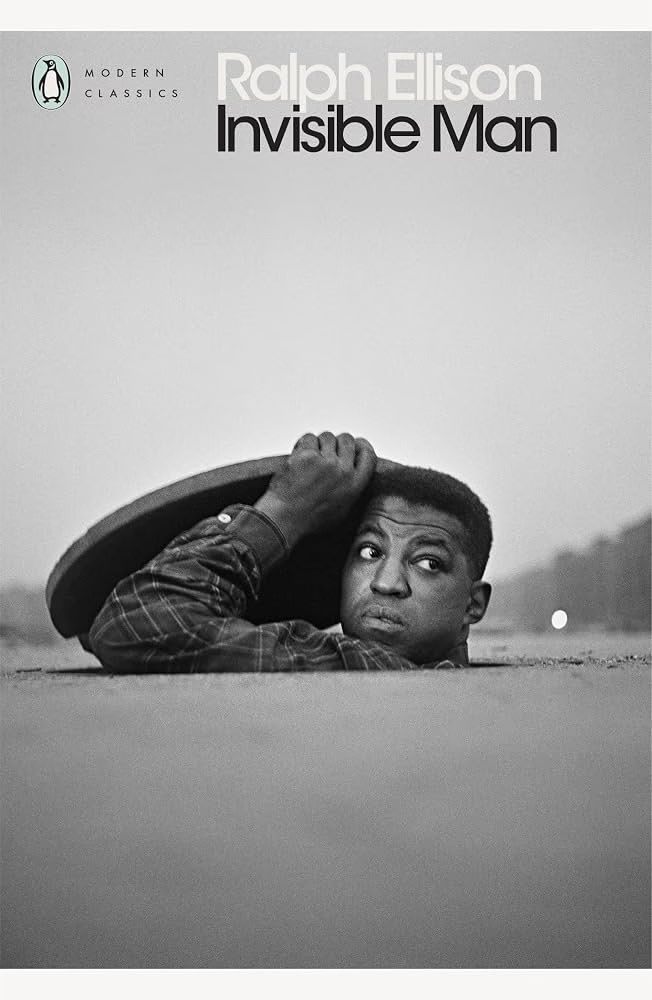
Our book choice for September 2026 is Invisible Man by Ralph Ellison. This 1952 masterpiece stands as a landmark of modernist literature — an incisive bildungsroman that interrogates identity, power, and the existential struggle for individual agency in mid-twentieth-century America.
Framed from a subterranean Harlem basement illuminated by 1,369 light bulbs powered by pirated electricity, an unnamed Black narrator recounts the odyssey that drove him underground: a condition born not of physical absence, but of society’s refusal to perceive his actual humanity.
The narrative traces his journey from the Jim Crow South to the disorienting verticality of New York City. In the South, his naive aspirations of upward mobility are shattered by the sadistic hypocrisy of white patronage — crystallised in the brutal opening ‘Battle Royal’ — and the cynical pragmatism of his college’s administration. Expelled and sent north, he seeks economic survival and a coherent role within the metropolis, only to find that Northern institutions enforce their own subtler mechanisms of commodification and erasure.
When his natural oratorical talents attract the attention of ‘The Brotherhood’ — a powerful, collectivist political organisation modelled on the American Communist movement — he believes he has finally found a vehicle for meaningful social transformation. Instead, he quickly discovers that rigid ideological dogma demands the total subsumption of individual complexity. Caught between the Brotherhood’s programmatic historicism, the emergent Black nationalism of street orator Ras the Exhorter, and the fluid, chaotic opportunism of Harlem street life, he is forced to recognise how every faction seeks to project its own designs onto his blank slate.
Ellison synthesises Dostoevskian existentialism, vernacular blues traditions, and the improvisational polyphony of jazz to craft a narrative that transcends standard protest fiction. Rather than relying on didactic polemic, the novel offers an unsparing analysis of how both institutional racism and totalitarian ideologies distort human perception.
For reading groups, Invisible Man offers fertile ground for debate, challenging members to examine how visibility is mediated by power, whether true self-definition is possible within collective movements, and what the narrator’s final underground stance reveals about the democratic promise.
Discussion Questions
- The narrator opens by declaring that his invisibility is not a biological accident, but “a figure of speech” caused by the construction of other people’s eyes. Looking at the major institutions he encounters—the Southern college, the Liberty Paints factory, and the Brotherhood—how do they each demand that he disappear into a predefined role to be of use to them? Are there moments where he complicitly trades his visibility for safety or status?
- The sequence at the Liberty Paints plant, where ten drops of dead-black chemical make the paint the whitest white, remains one of the most vivid set-pieces in American fiction. Beyond the obvious political metaphor, what did you make of Brockway’s fierce, territorial pride in operating the boilers? How does Ellison complicate our sympathy for the men who actually make these corrupt systems run?
- From the horrific battle royale speech to the impromptu eviction eulogy and his mass rallies for the Brotherhood, the narrator repeatedly discovers the intoxicating power of his own rhetoric. Does language ever function as genuine self-expression for him, or is it always an instrument of persuasion tailored to someone else’s script?
- The narrator is haunted throughout the book by his dying grandfather’s deathbed advice: “Agree ’em to death and destruction, let ’em swoller you till they vomit or bust wide open.” By the end of the narrative, do you think the narrator has solved this riddle, rejected it, or become a victim of it? Is malicious compliance a viable form of resistance, or merely a rationalisation of surrender?
- Brother Jack and the committee treat history as a mechanistic science, viewing people as instruments rather than individuals. For a novel published in 1952, how sharply does Ellison’s critique of bureaucratic, ideologically rigid organisations land today? Did the Brotherhood’s paternalism strike you as distinct from Mr. Norton’s, or simply a modernised, Northern iteration of the same impulse?
- Dr. Bledsoe is easy to loathe, yet his confrontation with the narrator contains an unsettling, brutal realism: “I’s big and you’s little and don’t you forget it.” How did you react to Bledsoe’s cynical calculus of power? Does Ellison invite us to see him purely as a traitor to his race, or as an unsparing pragmatist who understands the real machinery of the world far better than the naive narrator?
- When the narrator slips on dark glasses and a wide-brimmed hat, he is instantly mistaken for “Rinehart”—a preacher, bookie, lover, and briber all at once. What does the revelation of Rinehart’s boundless, formless opportunism do to the narrator’s psyche? Is Rinehart’s complete lack of an essential self the dark logical extreme of living in an absurd world?
- Tod Clifton’s defection from the Brotherhood to sell paper Sambo dolls on the street corner is one of the novel’s most jarring narrative pivots. Why does Clifton choose deliberate, grotesque humiliation over continued political discipline? What broke in him, and what does his public death say about the cost of maintaining one’s sanity inside an ideological machine?
- The novel begins with grounded, evocative Southern realism and gradually dissolves into expressionism, delirium, and apocalyptic satire during the Harlem riots. Did this formal metamorphosis work for you as a reader, or did you find yourself missing the tighter, naturalistic grip of the earlier chapters? How does the shifting aesthetic reflect the narrator’s fracturing hold on reality?
- The Underground and the Final Sentence
- The narrator spends his hibernation listening to Louis Armstrong, draining 1,369 lightbulbs’ worth of power from Monopolated Light & Power, and writing his story. Yet in the Epilogue, he decides he must emerge from the hole. Why? And how do you interpret that enigmatic final line: “Who knows but that, on the lower frequencies, I speak for you?”
Individual Ratings
DKB's Rating 

Hayley's Rating
Sue's Rating 
Baljit's Rating