
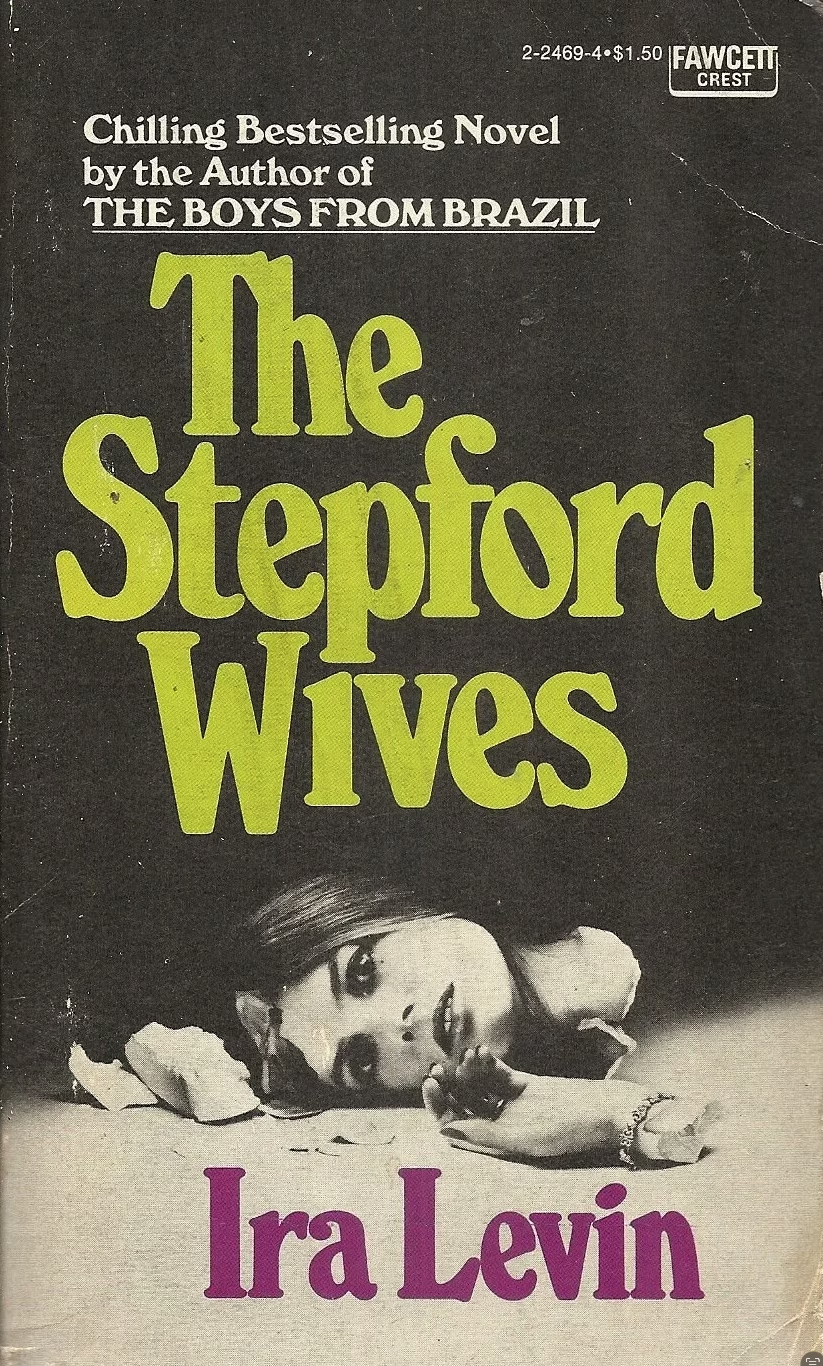
Our book group choice for July 2026 is The Stepford Wives by Ira Levin. It is a potent techno-gothic critique of patriarchal anxiety, consumer capitalism, and the violent backlash against second-wave feminism.
The narrative follows Joanna Eberhart, a talented amateur photographer and liberal-minded mother, who relocates from Manhattan to the idyllic, affluent suburb of Stepford, Connecticut. Initially seeking a healthier environment for her family, Joanna is quickly unsettled by the local women, who exhibit a mechanical devotion to domestic servitude, an absence of intellectual curiosity, and an uncanny obsession with physical perfection and cleanliness.
Levin utilises Joanna’s investigation into the community to construct a profound psychological thriller that doubles as a sociological horror. Alongside her fellow newcomer, Bobbie Markowe, Joanna attempts to establish a local consciousness-raising group, only to find the suburban landscape entirely hostile to female solidarity. As Bobbie and other independent women are systematically transformed overnight into docile, hyper-sexualised caricatures of domestic bliss, Joanna uncovers the sinister architecture of the Stepford Men’s Association. This exclusive, panoptic fraternal order leverages cybernetic technology to murder their wives and replace them with subservient animatronic duplicates.
The novel operates as a brilliant allegory for the commodification of the female body and the erasure of female identity under the guise of suburban utopianism. By replacing autonomous women with custom-manufactured consumer goods, Levin illustrates how the patriarchal structure seeks to neutralise the threat of feminist liberation. The chilling conclusion, wherein a lobotomised, robotic Joanna glides through the local supermarket, underscores the absolute obliteration of the female subject. The Stepford Wives remains a seminal text in American literature, exposing the terrifying intersection where technological advancement is weaponised to enforce rigid gender conformity and domestic subjugation.
Discussion Questions
- Levin published The Stepford Wives in 1972, at the height of the Women’s Liberation Movement. Is the men’s conspiracy best understood as a literal sci-fi plot, or as an allegorical manifestation of suburban, middle-class male anxiety in response to shifting gender dynamics? How does the novel frame suburbanisation itself as an instrument of reactionary control?
- The replaced wives do not merely become submissive; they become obsessed with domestic labour, commercial products, and spotless aesthetic presentation. How does Levin link patriarchal subjugation directly to post-war consumer capitalism and advertising culture?
- Levin translates traditional Gothic conventions—the isolated heroine, the uncanny double, the hostile environment, the secretive male enclave—into a bright, sunny American suburb. How effectively does The Stepford Wives function as a “techno-gothic” narrative, and what does the mundane setting add to its psychological horror?
- Joanna is an semi-professional photographer who prides herself on keen observation, yet she repeatedly rationalises or dismisses the unsettling shifts in her peers until it is too late. How does Levin deploy her artistic lens, and to what extent does her initial desire to fit into Stepford compromise her critical instincts?
- The Men’s Association functions as a shadow governance structure within the town, leveraging corporate, technological, and chemical expertise (via figures from aerospace, computer engineering, and animatronics). How does the novel comment on the way male solidarity crosses professional and institutional lines to preserve structural dominance?
- Bobbie serves as Joanna’s primary intellectual and emotional ally, making her sudden transformation the novel’s most jarring horror beat. Why is Bobbie’s shift from messy, free-thinking intellectual to immaculate, docile homemaker so viscerally effective, and how does Levin use her character to signal the futility of individual resistance?
- Throughout the novel, Joanna’s concerns are systematically trivialised by Walter and attributed to her own neuroses or inability to settle into suburban life. How does the narrative build a sense of epistemic isolation, and how does this mirror real-world dynamics of psychological manipulation?
- Joanna’s photography and Bobbie’s writing represent creative and financial independence outside the domestic sphere. Why is the eradication of women’s independent labor and intellectual life so central to the Men’s Association’s project, and what does this suggest about the relationship between financial independence and female agency?
- Freud defined the uncanny as something familiar that has been made strange or alienated. In what ways do the transformed wives exemplify the uncanny? How does Levin balance the absurd, almost pulpy nature of automated replicas with genuine psychological dread?
- At under 150 pages, Levin’s prose is lean, fast-paced, and devoid of excess exposition. How does this structural brevity impact the novel’s tension?
- Given how the term “Stepford wife” entered the popular lexicon—often stripped of Levin’s darker critique—does the novel’s original bite remain intact when read today?e
- To whom would you recommend this?
Individual Ratings
Catherine's Rating 
DKB's Rating
Jo's Rating
EmmaT's Rating
Willow's Rating 
Kelby's Rating
Hayley's Rating
Sue's Rating 