
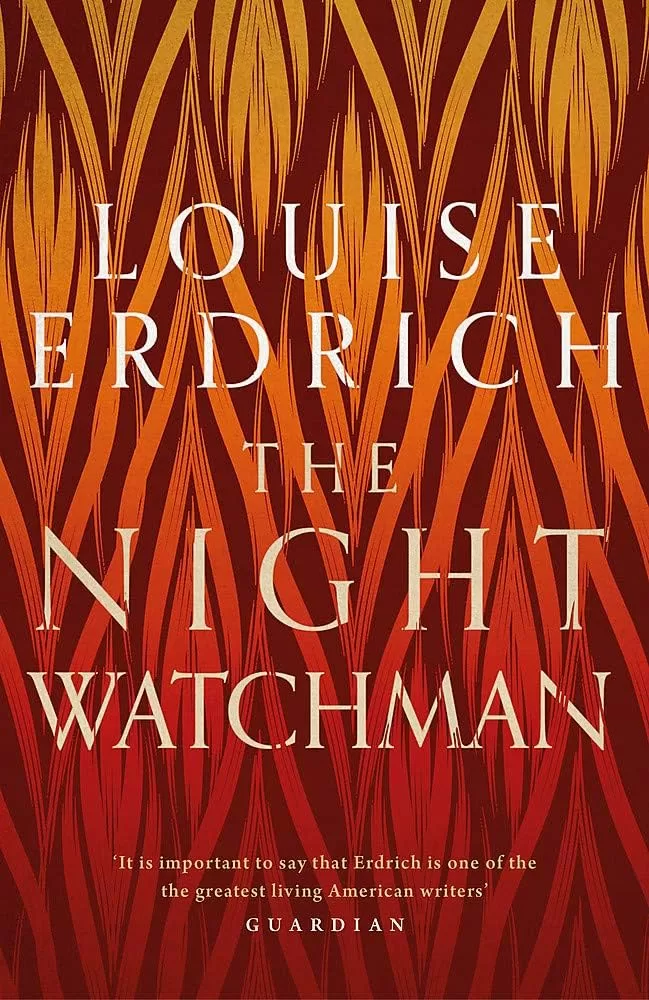
Our book group choice for October 2025 is The Night Watchman by Louise Erdrich. A work of historical fiction set in the 1950s, the narrative takes place on a Chippewa reservation in North Dakota and examines the political and personal ramifications of a proposed piece of legislation.
The story follows two main characters. Thomas Wazhashk, a night watchman at a jewel-bearing plant, is also a member of the tribal council. He learns of the U.S. Congress’s pending House Concurrent Resolution 108, a bill that would legally “terminate” Native American tribes. This action would nullify their treaties and strip them of their land and federal services. In response, Thomas initiates a campaign to oppose the resolution, which includes writing letters to government officials and travelling to Washington, D.C.
The second narrative thread follows Patrice Paranteau, a young woman who works with Thomas at the factory. Seeking financial stability for her family, Patrice travels to Minneapolis to find her older sister, Vera, who has disappeared. Her journey takes her from the reservation to a new environment, where she experiences the hardships and challenges of urban life.
The novel connects these two distinct journeys, exploring themes of tribal sovereignty, cultural identity, and the economic and social pressures faced by Native people in the mid-20th century. The historical context of the termination policy serves as the backdrop for the characters’ individual and communal struggles.
Discussion Questions
- Did you finish the book? Did you like it?
- Louise Erdrich is known for her lyrical prose, did anything resonate with you?
- The novel is rooted in the real history of the Turtle Mountain Band’s resistance to the US government’s “termination” policy. How well did Erdrich balance the political history with the fictionalised personal stories?
- Thomas, inspired by Erdrich’s grandfather, is a night watchman but also a community leader. How do you think he shapes the novel’s moral centre?
- How effective is he as a character in representing both individual struggle and collective resistance?
- Patrice’s journey from her factory work to her dangerous search for Vera offers a stark contrast to Thomas’s story. What does Patrice’s storyline reveal about women’s in mid-20th century Native communities?
- Erdrich uses multiple perspectives and intertwines many lives. How did this affect your reading experience?
- Dreams, visions, and spiritual presences thread through the narrative. How do these elements sit alongside the novel’s political realism?
- Factory work, boxing, sex work, and labour in general all play central roles. What is the novel saying about dignity, exploitation, and the value of work, particularly in marginalised communities?
- Although set in the 1950s, the novel resonates with present-day questions of Indigenous rights, land, and sovereignty. Did you draw any parallels with contemporary issues?
Individual Ratings
EmmaT's Rating 

Catherine's Rating
Hayley's Rating
Sue's Rating
Baljit's Rating
Kelby's Rating 
DKB's Rating