
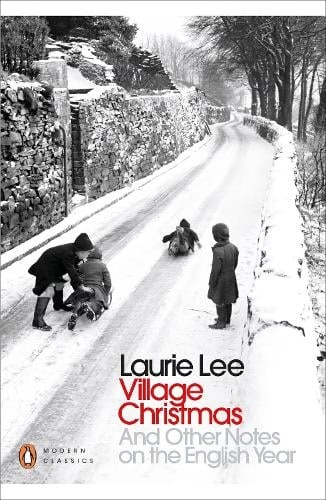
Our book group choice for December 2025 is Village Christmas by Laurie Lee. For many readers, Laurie Lee is synonymous with the sun-drenched, cider-hazed memories of the Slad Valley immortalised in his classic, Cider with Rosie. But if Cider with Rosie is the golden heat of high summer, Village Christmas is the crisp, woodsmoke-scented chill of midwinter.
Published posthumously, this slender but substantial collection serves as a perfect companion piece to Lee’s more famous memoirs. It is not a single continuous narrative, but rather a patchwork quilt of essays, broadcast scripts, and magazine pieces that were rediscovered and woven together after his death.
The Ghosts of Christmas Past
The title piece alone is worth the price of admission. Lee transports us back to a time before commercialisation smoothed the rough edges off the festive season. His Christmas is not the sanitised version found on modern greeting cards; it is visceral, cold, and communal. He writes of the ‘violent, wet, windy’ winters of the Cotswolds, where carol singing was a serious financial enterprise for village children, and the festive feast was a hard-won triumph over wartime scarcity or rural poverty.
He vividly describes the chaotic warmth of the family kitchen, the steaming puddings, and the rough music of the local waits. There is a haunting beauty in his recollection of trudging through the snow to the Squire’s house, a stark reminder of the rigid class structures that once defined rural England.
Beyond the Slad Valley
However, the subtitle, And Other Notes on the English Year, is crucial. The book moves beyond the festive season to explore the turning of the year and the wider geography of Lee’s life. We are taken from the silence of a Cotswold winter to the blossoming of spring and the harvest.
Crucially, the collection also showcases Lee the Londoner. Essays detailing his time in Chelsea—specifically the boisterous, bohemian chaos of the Chelsea Arts Ball—provide a startling contrast to the quietude of the countryside. This duality offers a fascinating talking point for groups: the tension between the rural idyll Lee is famous for and the modern, urban reality he actually lived in for much of his life.
Village Christmas is, at its heart, a lament for a vanishing world. Lee’s prose acts as amber, preserving the insects and flora of a way of life that has largely disappeared.
Discussion Questions
To come
Individual Ratings
EmmaJ's Rating 

Willow's Rating
Sue's Rating
EmmaT's Rating
Baljit's Rating
Anthony's Rating
Catherine's Rating
Kelby's Rating
Hayley's Rating
DKB's Rating