
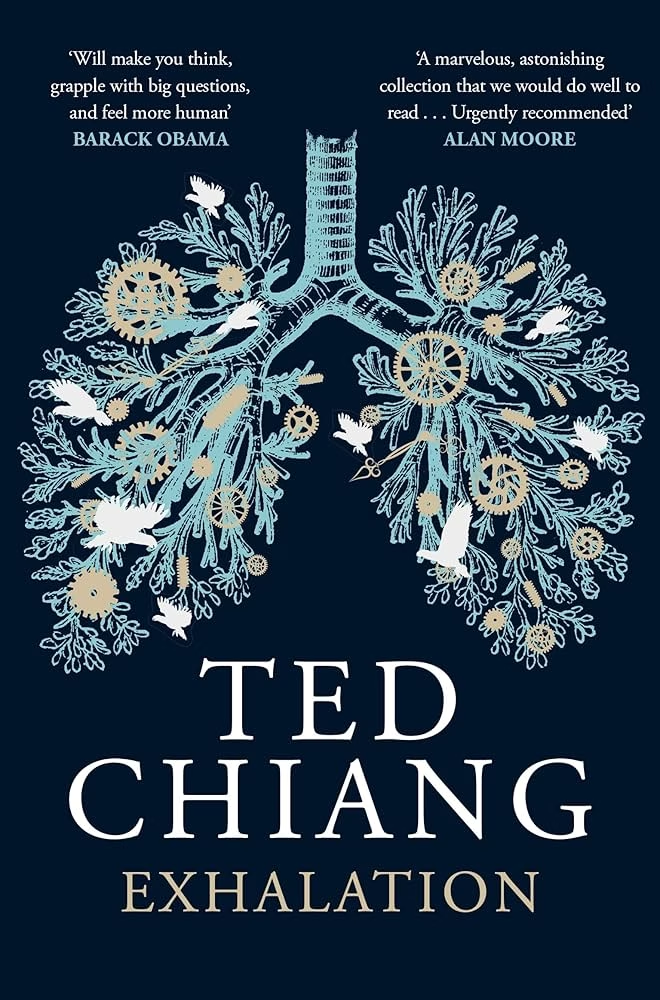
Our book group choice for January 2026 is Exhalation by Ted Chiang. Exhalation is a collection of nine speculative fiction stories; rather than a single novel, this book functions as an anthology of distinct narratives, each exploring profound philosophical questions through the lens of science fiction and fantasy.
While the settings range from ancient Baghdad to futuristic digital landscapes, the collection is unified by its deep interrogation of what it means to be human in a universe governed by physical laws and advancing technology.
Exploring the Collection
The book opens with ‘The Merchant and the Alchemist’s Gate’, a fable-like tale set in medieval Baghdad. It follows a fabric merchant who discovers a portal capable of transporting travellers twenty years into the past or future. Unlike typical time-travel adventures that focus on changing history, this story meditates on the nature of fate, the permanence of the past, and the possibility of finding peace with one’s mistakes.
In the title story, ‘Exhalation’, Chiang presents a universe inhabited by mechanical beings powered by argon gas from deep within the earth. As their atmospheric pressure begins to equilibrate, threatening their existence, an anatomist dissects his own brain to understand the relationship between memory, consciousness, and the inescapable law of entropy. It is a melancholic yet beautiful examination of mortality and the legacy of civilisations.
A significant portion of the book is dedicated to the novella ‘The Lifecycle of Software Objects’. This story traces the lives of ‘digients’—digital pets with artificial intelligence—and the human owners who raise them over the course of a decade. It moves beyond the technical aspects of AI to explore the emotional labour of parenting, the ethics of digital sentience, and how commercial obsolescence affects relationships.
Another standout is ‘Anxiety Is the Dizziness of Freedom’, which introduces a device called a ‘prism’ that allows users to communicate with their ‘paraselves’ in parallel timelines. The narrative weaves together the lives of several characters using these prisms to grapple with regret, jealousy, and the moral weight of the choices they did—or did not—make.
Core Themes
Chiang’s writing is often described as ‘philosophical science fiction’. He uses high-concept premises not for the sake of spectacle, but to conduct thought experiments on the human condition. Recurring themes in Exhalation include:
- Free Will vs. Determinism: Many stories ask whether we truly have control over our actions or if our paths are pre-written by physics or time.
- Memory and Truth: Stories like ‘The Truth of Fact, the Truth of Feeling’ contrast organic, fallible human memory with precise digital recording, asking if total recall is actually beneficial for human relationships.
- Entropy and Loss: There is a pervasive sense of the finite nature of things, urging readers to value the present moment.
Exhalation offers a methodical and empathetic look at the intersection of humanity and machinery. It challenges readers to consider how technology shapes our ethics and our understanding of the self, leaving them with complex questions long after the final page is turned.
Discussion Questions
- To come.
Individual Ratings
Willow's Rating 

Anthony's Rating
Catherine Rating 
Jo's Rating
Kelby's Rating
Baljit's Rating
DKB's Rating
Sue's Rating
Hayley's Rating